【论文信息】
Liu Y, Zhang Y, Liu S, & Sui R. Service configuration and demand information sharing in a hybrid tourism platform supply chain[J]. Industrial Management & Data Systems(SCI, JCR Q1,2025中科院3区), 2026: 1-33. DOI:10.1108/IMDS-03-2026-0415.
【作者信息】
第一作者:刘益,管理学博士、硕士研究生导师,研究方向:旅游平台供应链管理、文旅融合;
第二作者/通讯作者:张艺婕,刘益博士指导的2024级硕士研究生,研究方向:旅游平台供应链管理;
第三作者:刘胜盛,刘益博士指导的2025级硕士研究生,研究方向:旅游平台供应链管理;
第四作者:眭蓉华,管理学博士、副教授、硕士研究生导师,研究方向:平台供应链管理。
【基金支持】
重庆市社会科学规划项目(2023BS040);重庆市教育委员会科学技术研究计划(KJQN202300825,KJQN202300827);重庆市自然科学基金(CSTB2023NSCQ-MSX0903);重庆工商大学高层次人才启动项目(2355040);重庆工商大学研究生创新项目(yjscxx2025-269-78)。
【论文摘要】
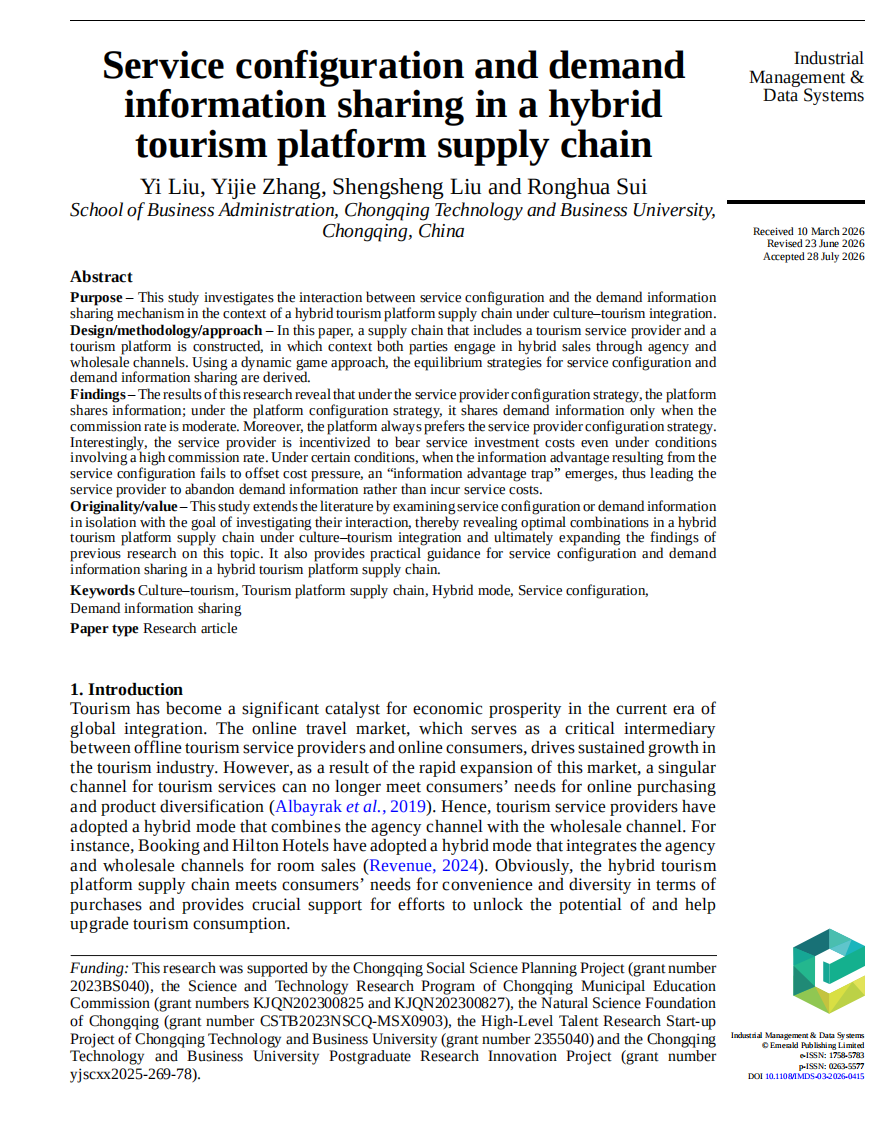
Purpose—This study investigates the interaction between service configuration and the demand information sharing mechanism in the context of a hybrid tourism platform supply chain under culture–tourism integration.
Design/methodology/approach—In this paper, a supply chain that includes a tourism service provider and a tourism platform is constructed, in which context both parties engage in hybrid sales through agency and wholesale channels. Using a dynamic game approach, the equilibrium strategies for service configuration and demand information sharing are derived.
Findings—The results of this research reveal that under the service provider configuration strategy, the platform shares information; under the platform configuration strategy, it shares demand information only when the commission rate is moderate. Moreover, the platform always prefers the service provider configuration strategy. Interestingly, the service provider is incentivized to bear service investment costs even under conditions involving a high commission rate. Under certain conditions, when the information advantage resulting from the service configuration fails to offset cost pressure, an “information advantage trap” emerges, thus leading the service provider to abandon demand information rather than incur service costs.
Originality/value—This study extends the literature by examining service configuration or demand information in isolation with the goal of investigating their interaction, thereby revealing optimal combinations in a hybrid tourism platform supply chain under culture–tourism integration and ultimately expanding the findings of previous research on this topic. It also provides practical guidance for service configuration and demand information sharing in a hybrid tourism platform supply chain.