【论文信息】
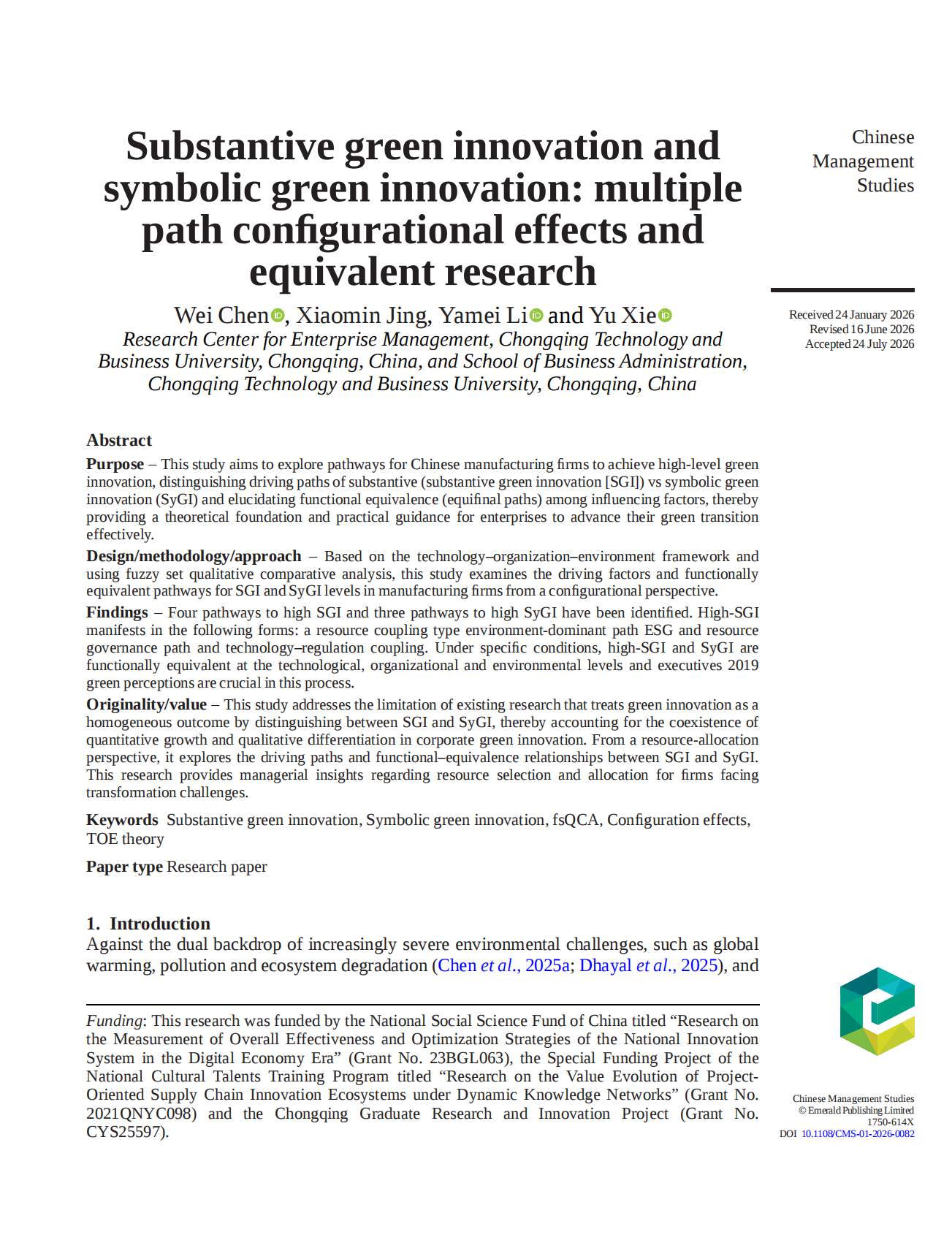
Chen W, Jing X M, Li Y M*(通讯作者), Xie Y.Substantive green innovation and symbolic green innovation: multiple path configurational effects and equivalent research[J].Chinese Management Studies (SSCI JCR Q2,新锐三区,FMS管理科学高质量国际期刊C级).2026. DOI:10.1108/CMS-01-2026-0082.
【作者信息】
第一作者:陈 伟,管理学博士、教授、博士生导师,研究方向:技术创新管理;
第二作者:景小敏,陈伟教授指导的2024级硕士研究生,研究方向:技术创新管理;
通讯作者:李亚美,陈伟教授指导的2025级博士研究生,研究方向:技术创新管理;
第四作者:谢 瑜,管理学博士、副教授、硕士生导师,研究方向:技术创新管理。
【基金支持】
国家文化英才培养工程专项资助项目(2021QNYC098);国家社会科学基金项目(批准号:23BGL063)。
【论文摘要】
Purpose– This study aims to explore pathways for Chinese manufacturing firms to achieve high-level green innovation, distinguishing driving paths of substantive (substantive green innovation [SGI]) vs symbolic green innovation (SyGI) and elucidating functional equivalence (equifinal paths) among influencing factors, thereby providing a theoretical foundation and practical guidance for enterprises to advance their green transition effectively.
Design/methodology/approach– Based on the technology–organization–environment framework and using fuzzy set qualitative comparative analysis, this study examines the driving factors and functionally equivalent pathways for SGI and SyGI levels in manufacturing firms from a configurational perspective.
Findings– Four pathways to high SGI and three pathways to high SyGI have been identified. High-SGI manifests in the following forms: a resource coupling type environment-dominant path ESG and resource governance path and technology–regulation coupling. Under specific conditions, high-SGI and SyGI are functionally equivalent at the technological, organizational and environmental levels and executives 2019 green perceptions are crucial in this process.
Originality/value– This study addresses the limitation of existing research that treats green innovation as a homogeneous outcome by distinguishing between SGI and SyGI, thereby accounting for the coexistence of quantitative growth and qualitative differentiation in corporate green innovation. From a resource-allocation perspective, it explores the driving paths and functional–equivalence relationships between SGI and SyGI. This research provides managerial insights regarding resource selection and allocation for firms facing transformation challenges.