【论文信息】
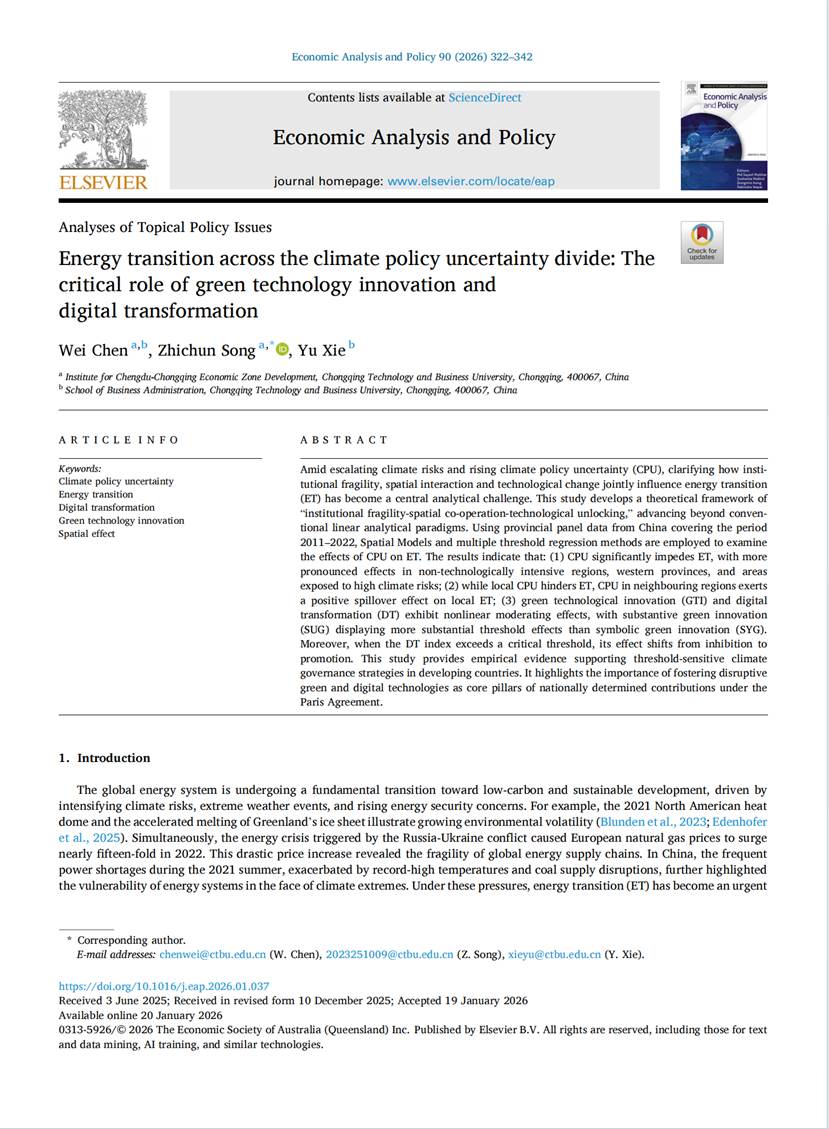
Chen W, Song Z C*(通讯作者), Xie Y Energy transition across the climate policy uncertainty divide: The critical role of green technology innovation and digital transformation[J]. Economic Analysis and Policy (SSCI JCR Q1,中科院SSCI二区TOP期刊). 2026, 90: 322-342.https://doi.org/10.1016/j.eap.2026.01.037.
【作者信息】
第一作者:陈伟,博士、教授、博士生导师,研究方向:供应链管理、技术创新管理;
通讯作者:宋志春,2023级博士研究生,研究方向:能源技术创新。
【基金支持】
国家文化英才培养工程专项资助项目(2021QNYC098);国家社会科学基金项目(23BGL063)。
【论文摘要】
Amid escalating climate risks and rising climate policy uncertainty (CPU), clarifying how institutional fragility, spatial interaction and technological change jointly influence energy transition (ET) has become a central analytical challenge. This study develops a theoretical framework of “institutional fragility-spatial co-operation-technological unlocking,” advancing beyond conventional linear analytical paradigms. Using provincial panel data from China covering the period 2011–2022, Spatial Models and multiple threshold regression methods are employed to examine the effects of CPU on ET. The results indicate that: (1) CPU significantly impedes ET, with more pronounced effects in non-technologically intensive regions, western provinces, and areas exposed to high climate risks; (2) while local CPU hinders ET, CPU in neighbouring regions exerts a positive spillover effect on local ET; (3) green technological innovation (GTI) and digital transformation (DT) exhibit nonlinear moderating effects, with substantive green innovation (SUG) displaying more substantial threshold effects than symbolic green innovation (SYG). Moreover, when the DT index exceeds a critical threshold, its effect shifts from inhibition to promotion. This study provides empirical evidence supporting threshold-sensitive climate governance strategies in developing countries. It highlights the importance of fostering disruptive green and digital technologies as core pillars of nationally determined contributions under the Paris Agreement.